
 Panthers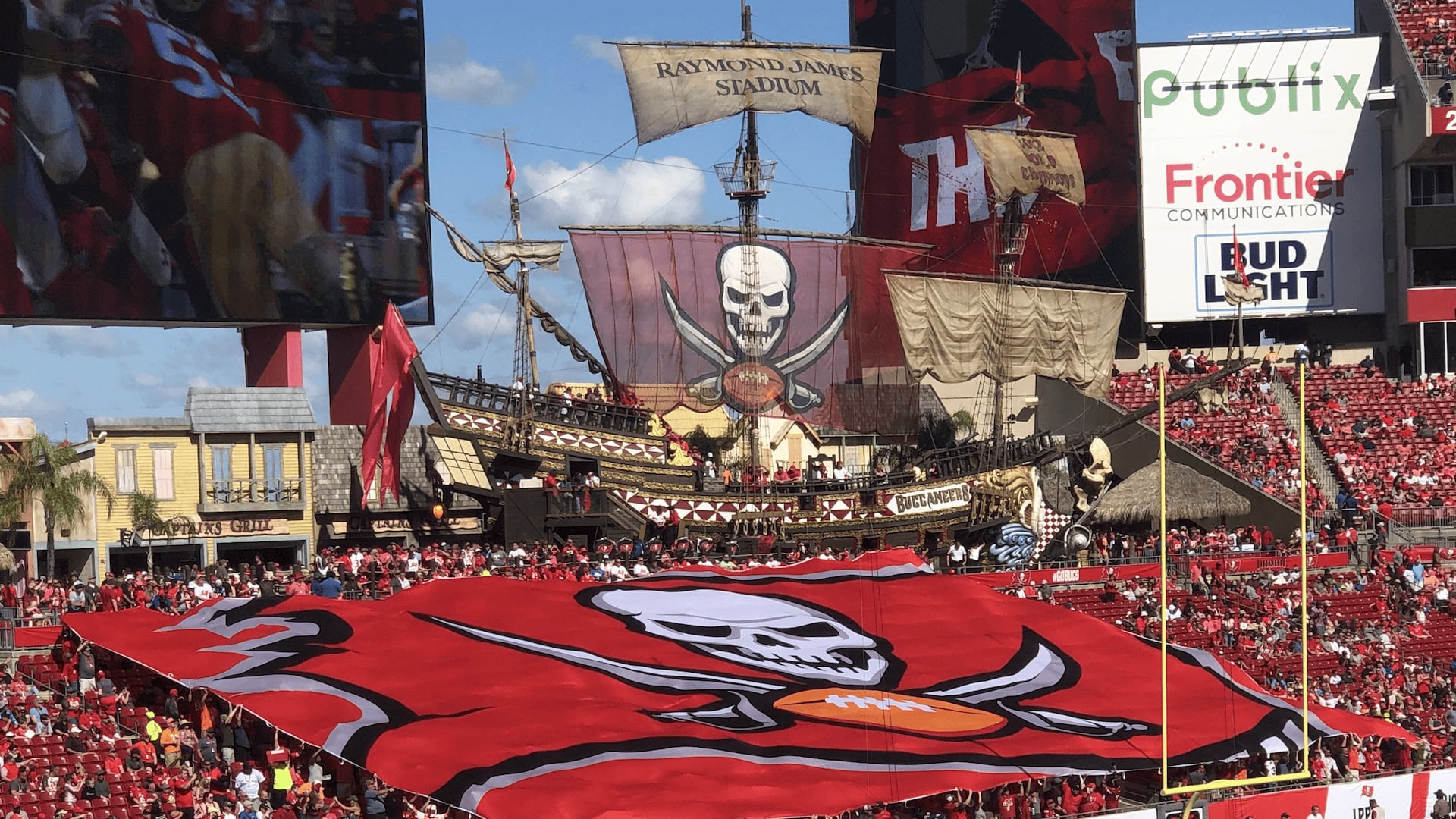
A fan watching from a bar in Manchester or an apartment in Sao Paulo hears it before they understand it: a low boom, then another, then another, rolling through the stadium mix on the TV broadcast. Nobody explains it. It just happens, over and over, every time the Buccaneers score. Somewhere in the north end zone of Raymond James Stadium, a 103-foot pirate ship is firing its cannons, and it has been doing that since before most current Buccaneers players were born.
The ship is the single most recognizable physical feature of any NFL stadium. It is also, for a lot of international fans who have never set foot in Tampa, the part of the Buccaneers experience they know best and understand least. Here is where it came from, how it actually works, and the one night it was ordered to stay quiet.
Built in 71 days for a stadium that did not exist yet
When Raymond James Stadium opened in 1998, replacing the old Tampa Stadium known as the Big Sombrero, the Buccaneers did not simply add a mascot prop to the new building. They commissioned an entire themed environment.
The ship was built by Nassal, an Orlando-based company that specializes in building attractions for theme parks, the kind of firm normally hired by Disney or Universal rather than an NFL franchise. According to Nassal's own project page, the finished ship runs 103 feet long, sitting inside a themed area, Buccaneer Cove, that spans roughly 20,000 square feet and includes a 340-foot boardwalk and dock built around it. The Ringer's 2021 feature on the ship reported that Nassal built the whole thing in 71 days, working around the clock, at a cost of $3 million.
That is a lot of investment for something that exists purely to make noise and shoot smoke twice a quarter. It is also exactly why it still works almost thirty years later: it was never built like a stadium prop. It was built like a ride.
Buccaneer Cove has since taken on a second life beyond game days. Raymond James Stadium's own venue page lists the ship's deck alone at roughly 1,500 square feet, set inside a wider cove space of about 20,000 square feet with a capacity of 500 people, and rents it out for weddings, receptions and corporate events on non-game days. A structure built to survive an NFL season now also has to survive a wedding reception, which says something about how solidly Nassal put it together in the first place.
Seven shots for a touchdown, three for a field goal
The mechanics are more precise than most fans realize. According to Raymond James Stadium's own facilities page, and matched by the Tampa Bay Sports facility listing for the building, the ship's cannons "fire seven times to signal a touchdown and three to announce a field goal." They also fire during pregame player introductions, giving the ship its second big moment of every home game before a single snap has happened.
An animatronic parrot sits on the stern, controlled by a hidden operator on radio remote, said to be capable of picking out individual fans in the crowd and talking to people walking underneath it. It is a small detail, but it tells you something about the intent behind the whole structure: this was never meant to be a static replica. It was built to interact with the crowd around it, snap by snap, the same way a theme park animatronic is built to notice the people walking past.
The bird itself has had its own quiet history. The Ringer reported in its 2021 feature that the ship's original animatronic parrot had been removed by that point. The stadium's own current venue page, however, describes an active radio-controlled parrot that still talks to fans below today, which suggests the ship got its voice back at some point after 2021. It is a minor detail, but it is a reminder that the ship is maintained and updated rather than simply left to sit in the end zone gathering rust.
On game days, the ship is staffed by a crew in full pirate costume, a group The Ringer counted at around 30 people in 2021, some working the ship's mechanics and cannons while others perform for the crowd in Buccaneer Cove below. One of those crew members, cannon operator Cleveland Johnson, described the job to The Athletic's 2020 oral history of the ship in blunt, delighted terms: "I'm a Buccaneer fan. I get to watch the game for free?"
A mascot with his own shipwreck story
The Buccaneers have leaned into the theatrics further than most franchises would bother to. Their mascot, Captain Fear, has an official origin story published by the team itself: a bearded pirate captain, six-foot-two and 250 pounds, supposedly rescued by the Coast Guard from Tampa Bay waters in June 2000 with no memory of anything except once commanding a ship. That ship, the story goes, washed ashore separately and was repaired and permanently docked in Buccaneer Cove. Captain Fear was formally named after a public vote in July 2001, a process the team's own retelling admits got messy enough that "we narrowly avoided intervention by the state Supreme Court."
None of that is meant to be taken as literal team history, and BucsWorld is not reporting it as such. But it is a useful way to understand how seriously the organization treats the pirate theme: the mascot's entire backstory is built around explaining why there is a ship in the end zone in the first place. Few NFL teams bother writing that kind of lore for a costume.
The person inside the costume was just as real as the ship itself. Mike Mashke portrayed Captain Fear from the character's debut through 2006, spending seven years as the face, or rather the beard, of Buccaneer Cove before retiring from the role. Whoever wears the costume today inherits a job that is inseparable from the ship: Captain Fear's entire reason for existing, on paper, is to guard it.
The night the cannons went silent
For over two decades, the cannons fired freely, part of the deal every Buccaneers home game came with. That changed for exactly one night: Super Bowl LV, played at Raymond James Stadium on February 7, 2021, when the Buccaneers became the first team in NFL history to play a Super Bowl in their own stadium.
Because the league treats the Super Bowl as a neutral-site event regardless of where it is physically played, the NFL restricted the ship's signature feature for the occasion. According to reporting at the time and confirmed on the stadium's own history page, the cannons were not allowed to fire during the game itself, not even after a Buccaneers touchdown. They were permitted only during player introductions before kickoff. Then, after Tampa Bay beat the Kansas City Chiefs to win the title on home turf, the league let the ship make up for lost time: the cannons fired 31 times once the final whistle blew.
It remains the one occasion the ship's rules were rewritten for a single night, and the fact that the league felt the need to legislate around a fan-experience feature at all says something about how central it had become to the identity of the building. The NFL runs the Super Bowl as a neutral-site event as a matter of policy, regardless of which stadium hosts it, and stripping the Buccaneers of their own signature celebration for one night was the clearest possible sign of how unusual that arrangement was. No other team had ever had to ask the league's permission to fire its own cannons in its own building.
Why it still matters on a screen thousands of miles away
For a fan who has never been to Tampa, the ship is mostly a sound and a shape glimpsed in broadcast cutaways: smoke drifting off the bow, the boom timed to the extra point, a wide shot during a commercial break showing the whole thing rigged with sails against the Florida sky. It is easy to assume it is just another stadium gimmick, no different from a scoreboard graphic or a mascot t-shirt cannon.
It is not. It is a $3 million, 103-foot themed attraction built by the same kind of company that builds Disney rides, staffed by a standing crew of around thirty people every single home game, with firing rules precise enough that the league itself had to intervene once to override them. Almost every other NFL stadium marks a score with lights and a horn. Raymond James Stadium marks it with something that took 71 days to build and still needs a maintenance crew of pirates to run.
That is the part that travels through a television broadcast even when nothing else does. A fan in Munich or Manchester does not need to know the exact math behind seven shots for a touchdown to understand, instinctively, that this stadium takes its own theater seriously. The ship has been doing that job since 1998, long before Tampa Bay ever needed a marketing department to explain it to the rest of the world.

No comments yet. Start the conversation.