
 Panthers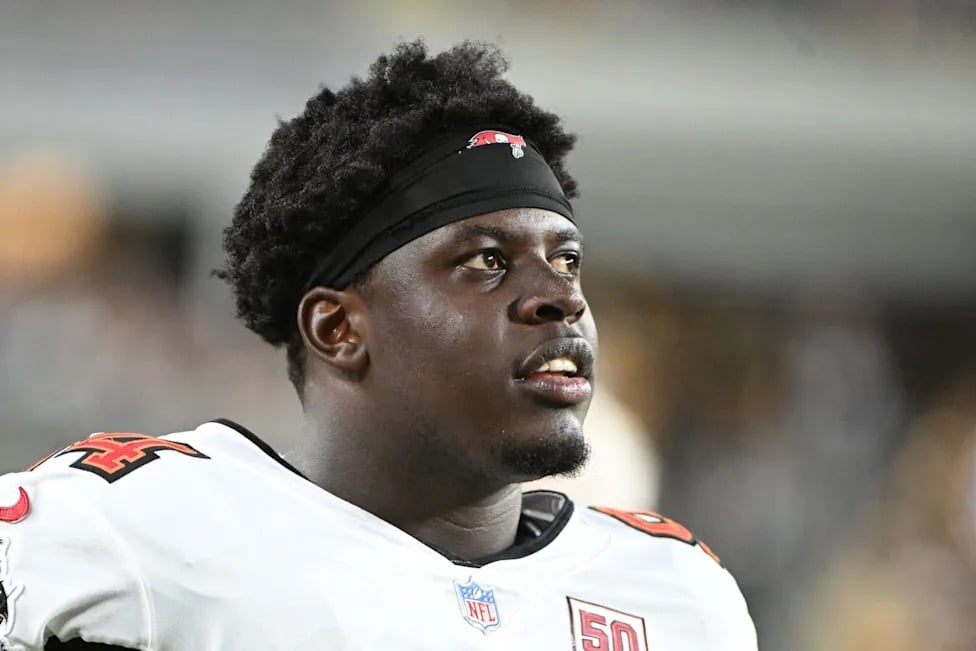
Every September, ESPN runs through all 32 NFL teams and names one player as that team's X-factor: not the biggest star, but the one whose performance swings the season the most in either direction. For Tampa Bay, national analyst Ben Solak picked a defensive tackle most casual fans outside the United States have never heard of. "He's a ceiling-raiser," Solak wrote of Calijah Kancey, adding the qualifier that matters most: only if healthy.
That single word, healthy, is the entire story. Kancey has flashed dominant football in flashes since he arrived in Tampa Bay, then lost most of an entire season to injury. Understanding why ESPN singled him out means understanding who he is, what he does on the field, and why one man's availability can bend an entire defense.
Who is Calijah Kancey
Kancey played college football at the University of Pittsburgh, where he became the school's first unanimous All-American defensive lineman since a player named Aaron Donald, a name that will come up again shortly. Tampa Bay drafted him with the 19th overall pick in the first round of the 2023 NFL draft, betting on a defensive tackle who did not look like a typical one.
At roughly 6 foot 1 and 280 pounds, Kancey is small for the interior of an NFL line, where blockers routinely outweigh him by 60 or 70 pounds. What he has instead is speed: at the 2023 NFL Scouting Combine he ran a 4.67 second 40-yard dash, the fastest time recorded by a defensive tackle since at least 2003, one hundredth of a second quicker than the mark Aaron Donald had set nearly a decade earlier. The comparison to Donald, one of the most disruptive interior defenders of his generation, followed Kancey through the draft process. It is not a perfect match. Analysts who studied both players noted Donald wins with better hand use and more strength at the point of attack, something Kancey was still developing as a rookie. But the athletic profile, undersized by position, freakishly quick off the snap, built to shoot gaps rather than hold a point, is the same blueprint.
What he did in 2023 and 2024
As a rookie in 2023, Kancey played 14 games and recorded 4.0 sacks and 26 tackles, numbers that undersell how disruptive he already looked as a first-year pass rusher learning a new position at the professional level. In 2024, working through his second season, he took a real step forward: 7.5 sacks and 28 tackles in only 12 games, a rate that would have projected to well over the double digit sack mark most teams consider elite production from an interior lineman, had he stayed on the field for a full slate. According to Next Gen Stats data cited by ESPN, Kancey ranked 15th among all defensive tackles in pressure rate in 2024, just behind teammate Vita Vea, and sixth in what analysts call get-off, the measure of how quickly a defender crosses the line of scrimmage after the snap. His average time to pressure that season was 2.77 seconds, well ahead of the 3.05 second league average for defensive tackles.
The season that got taken away
Then came 2025. Kancey started Tampa Bay's first two games of the year and was playing well before disaster struck: in Week 2, a Monday night win over the Houston Texans, he tore his pectoral muscle and left the game. An MRI confirmed the severity of the tear, and he had surgery that Friday. The initial expectation, confirmed by multiple outlets, was that his season was over.
It very nearly was. Kancey did not play again until Week 18, the final game of the regular season, when the Buccaneers activated him off injured reserve for a home matchup with Carolina and used him in a rotational role behind the defensive linemen who had taken his snaps all year. In between, he missed 14 straight games, essentially the entire heart of Tampa Bay's 2025 season, the stretch in which the Buccaneers collapsed from a 6-2 start to an 8-9 finish and missed the playoffs.
Why an interior pass rusher matters this much
To a reader new to American football, a defensive tackle can look like the least glamorous position on the field, a big body clogging the middle while the pass rush highlights go to edge rushers coming off the corner. That undersells what a good one does in Todd Bowles' scheme specifically.
Bowles has built his career around disguised pressure: blitzing linebackers, safeties and cornerbacks from angles the quarterback cannot see before the snap, and mixing in stunts, where two defensive linemen cross paths at the snap so one loops around the other to confuse which blocker is responsible for which rusher. Both tactics depend on an interior lineman who can win quickly on his own, because a stunt only works if at least one of the two crossing rushers threatens to beat his block immediately, and a blitz only creates real confusion if the base four man rush up front is already occupying blockers rather than getting neutralized one-on-one. As BucsWorld covered in The Todd Bowles defense, by the numbers, Tampa Bay blitzed 185 times in 2025, tied for the sixth most in the NFL, but those blitzes produced only 11 sacks all season, a return ranked among the league's worst. Kancey's absence for 14 of those games is not the only reason that number was so low, but a defensive tackle with a 2.77 second average time to pressure is exactly the kind of player who turns a blitz from a gamble into a two-way trap for the quarterback, and Bowles did not have him.
Kancey next to Vea
The other half of the equation is size. Vita Vea, Tampa Bay's 340-plus pound nose tackle, occupies blockers and holds the point of the run defense; as BucsWorld detailed after Vita Vea signs one-year, $30 million extension after summer trade request, the team fought to keep him rather than trade him this past summer specifically because of how central he remains to that front. Kancey and Vea are not redundant pieces, they are complementary ones: Vea absorbs the double teams a 340 pound man draws, which frees Kancey to work one-on-one against a guard who has to also worry about Vea next to him. When both are healthy, as they were briefly in Kancey's first two pro seasons, that pairing is what let Bowles disguise pressure from multiple spots on the same snap rather than asking one lineman to do it alone.
Tampa Bay signaled its own confidence in that pairing on April 27, 2026, when it exercised the fifth-year option on Kancey's rookie contract, locking him in for the 2027 season at a reported value around 14.5 million dollars, guaranteed for injury. It is a bet the team is willing to make again on a player who has now missed 22 games combined to injury across three seasons, three as a rookie, five in 2024, fourteen in 2025.
What to watch on Sunday
Tampa Bay opens the 2026 season on the road against the Cincinnati Bengals on Sunday, September 13, kickoff at 1:00 PM ET, 19:00 CEST, at Paycor Stadium. Head coach Todd Bowles has already previewed his ambitions for this front seven. Discussing his defensive line on the Ronde Barber Show earlier this month, Bowles said opponents would face "more of six- or seven-man protections than we've ever seen" against Tampa Bay this year, naming Kancey specifically alongside Vea, YaYa Diaby and rookie edge rusher Rueben Bain Jr. as players a blocking scheme cannot simply ignore.
That is the whole bet in one sentence. If Kancey lines up healthy and disruptive against Cincinnati and stays that way through the fall, Bowles gets the interior push his blitz-heavy scheme was missing for most of 2025, and the whole pass rush, not just one position, looks different. If the pectoral or some new injury takes him off the field again, Tampa Bay is back to relying on Elijah Roberts, who broke out in Kancey's absence last season, and a defensive line rotation still auditioning to prove it can pressure a quarterback without him. Watching Kancey's snap count and how often he collapses the pocket from the interior on Sunday is a more useful early signal for this defense's ceiling than the final score will be.
No comments yet. Start the conversation.